
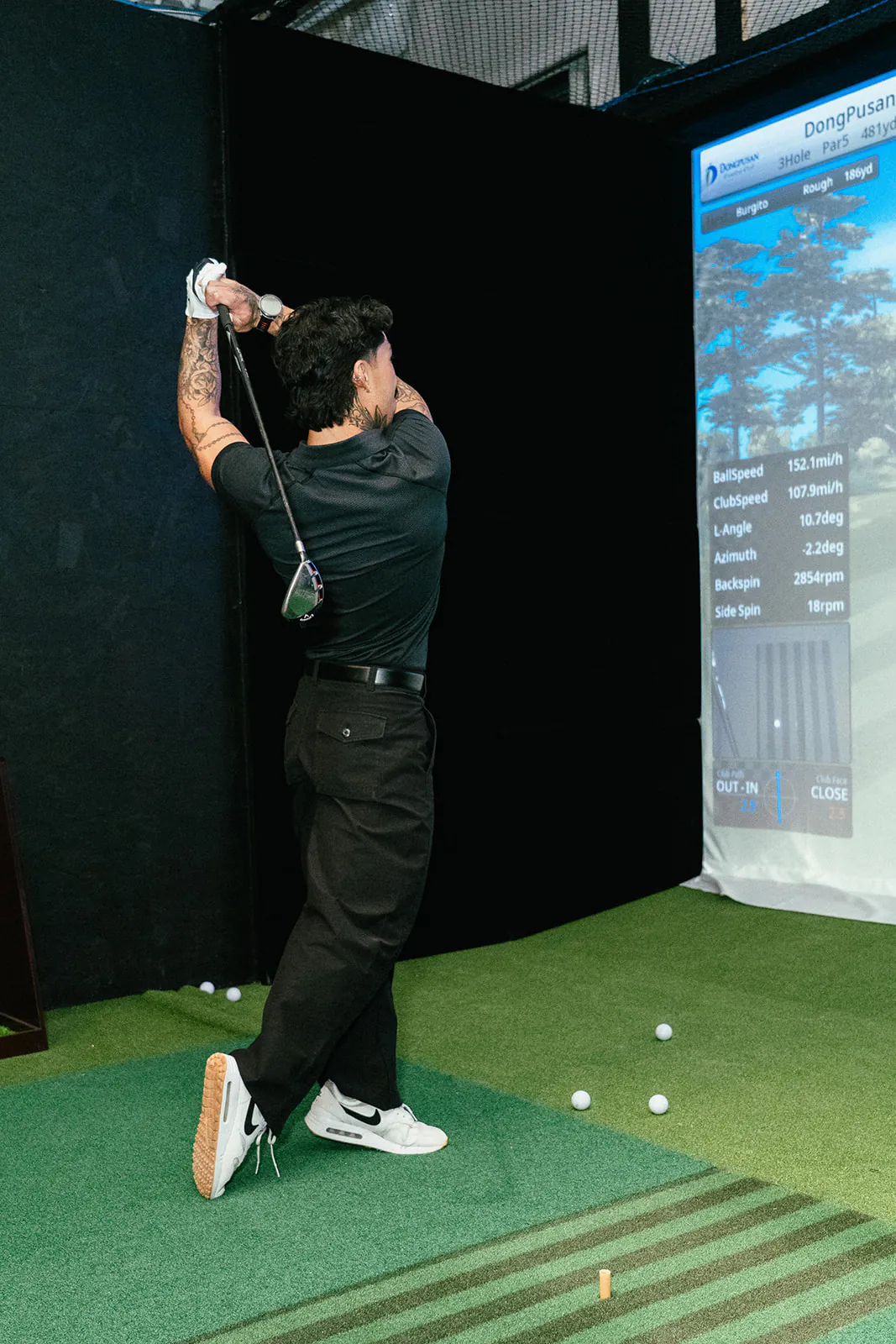
Most Calgary golfers do offseason golf practice the same way. Nothing at all until February, then a panicked fortnight of full drivers before the first round in April.
A better version is not more hours. It is the same hours with a different job each month, so that by the time the courses open you have built one thing instead of half-building four. Our post on when Calgary golf courses open covers how early day one usually arrives and what decides it.
What the offseason is actually for
Set the expectation before you book anything. Five months indoors will not rebuild a swing, and nobody can promise you strokes for turning up.
What it does reliably is three things: it keeps the motion you already have, it gives you room to change one thing without a scorecard watching, and it hands you a carry number for every club before you need one. Plan for those three and the winter pays for itself.
November: keep the swing and take a baseline
The season just ended, which makes this the cheapest month to get good information. Your swing is still the one you played with in September, so measure it now rather than in January when it has drifted.
Two sessions is enough. Hit every club in the bag, five or six balls each, and write down the middle carry rather than the best strike. Add one line on your miss pattern, left or right, heavy or thin. That page is the reference point for everything that follows, and it is the single most useful thing you will produce all winter.
Do not change anything in November. Measurement only.
December: fix one thing
Look at the November page and pick the one fault that costs you most. Usually it is strike, sometimes it is a start line, occasionally it is a club that is simply not in the bag for a reason. If it is a slice, start with how to fix a slice.
Then work on that one thing for the whole month. Same club, same drill, every session, with Swing Cam used twice a session to check what you feel against what you actually did. December is busy and sessions get missed, so pick something that survives an interrupted month.
One change per winter is not a modest ambition. It is the realistic one.
January: build speed
January is the dead centre of a Calgary winter and the best month for the work that needs no target. Speed is exactly that.
Add a short speed block to each session: ten minutes of hard swings with no interest in the result, watching club speed on screen and nothing else. Keep it away from the rest of the hour so you are not trying to swing fast and straight in the same ball.
Warm up properly first. A cold body and a maximum swing is how a winter plan ends in February with a sore back and no golf.
February: play, and add pressure
By February the change from December should feel normal enough to stop thinking about, which is the moment to stop drilling and start playing.
Spend most of each session on a course rather than the range. One ball, no reloads, keep the score, and play the shot the hole asks for instead of the one you feel like hitting. With more than 200 virtual courses in the bay there is no shortage of tests, and picking a hard course on purpose is more useful than picking a famous one.
This is also the month to rebuild the November chart. Your numbers will have moved, and the ones you carry into April should be the current ones.
March: sharpen before the first round
March is short, awkward and the most wasted month of the five. The temptation is to keep doing February. Do not.
- Wedges from real distances. Early-season rounds are usually decided inside 100 metres, and that part of the game goes stale fastest.
- A full routine on every ball. A routine built indoors is what survives the first tee.
- Putting, just to keep the stroke. Indoors it is a model of a green, not a green. Use it to keep the motion and expect to relearn speed outside.
- One last gapping check. Ten minutes, the clubs you actually hit into greens, numbers written down.
Then keep one session booked for the first week the courses open. The gap between the last indoor ball and the first outdoor one is where most of a winter gets lost.
If you only do one thing
Keep the November page. Every month after it is either measured against that sheet or guessed at, and guessing is what makes a winter of indoor golf feel like it achieved nothing. The detail of a single session is in our guide on how to practice on a golf simulator.
How often, and what it costs
A winter golf practice plan for Calgary lives or dies on frequency, not on cleverness. Once a week holds a swing together. Twice a week changes something. Below once a fortnight you are maintaining a hobby rather than running a plan, which is a perfectly reasonable choice as long as you know that is the choice.
Rates are per bay and per hour plus GST, not per person, so a winter partner running the same plan halves everyone's cost. Sunday to Thursday before 9 AM is $18 an hour, the cheapest band, and it happens to suit the short sessions this plan asks for. The rates page has the full board.
For twice a week across five months, look at the memberships instead. Night Owl at $129 a month plus GST covers unlimited bookings from 11 PM to 10 AM Sunday to Thursday, and from midnight to 10 AM on Friday and Saturday nights, which fits early risers and late finishers. The membership page sets out all three tiers.
Start in the first week of November
The plan only works if the baseline session happens while your season swing is still fresh, so the start date matters more than the schedule. Bays are open 24 hours a day, every day of the year, and the whole first session is one club at a time with a pen. Book an hour on the Calgary booking page and write your numbers down before the snow settles in.