
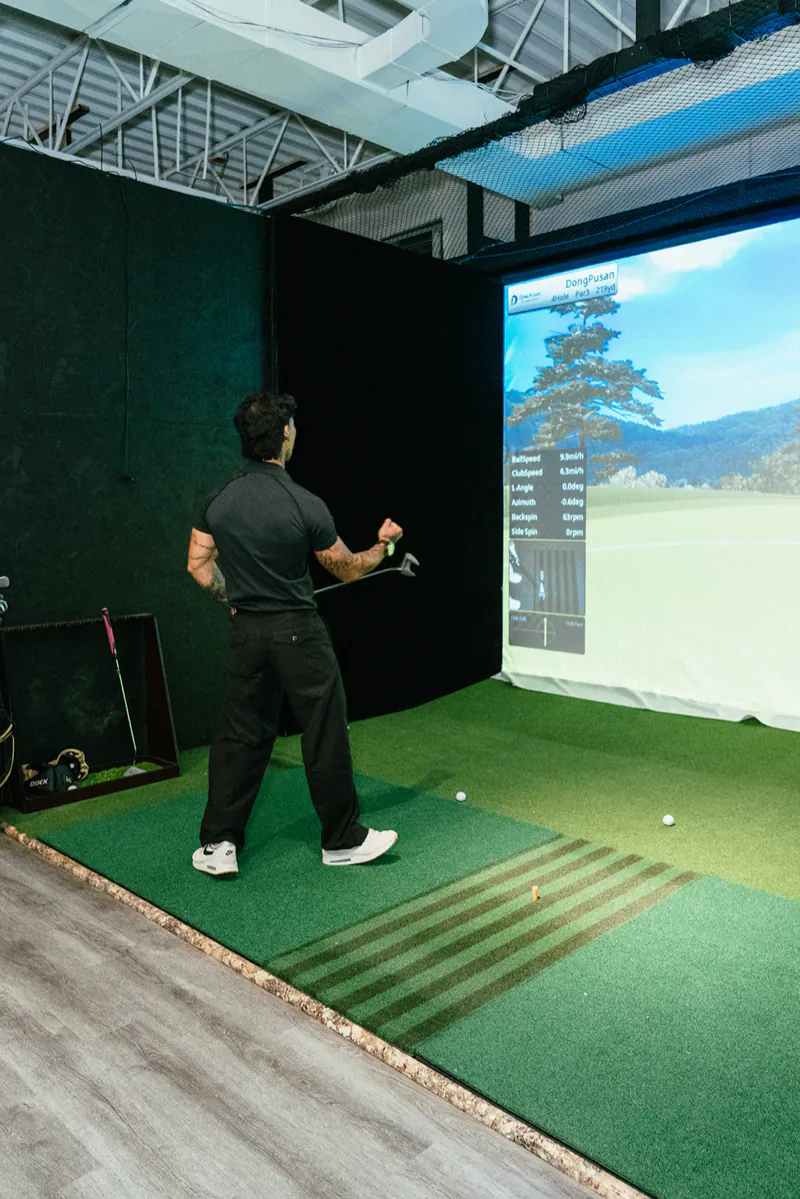
The default indoor hour goes like this. Driver, driver, driver, a couple of irons, a sore lower back, and no idea on the drive home whether anything moved.
Knowing how to practice on a golf simulator is mostly a scheduling problem. The bay gives you a reading after every ball, which is more information than a range bucket has ever given anyone, and information only helps if you decide in advance what you are looking for.
Three decisions before the clock starts
Make these in the car and the session runs itself.
- Pick one thing. One swing thought, or one number, for the whole hour. Two is already too many and three is a waste of a booking. If your one thing is a slice, start withhow to fix a slice.
- Pick a target for every block. The bay has a virtual driving range, so choose a distance and aim at it. A shot with no target is just exercise.
- Decide how you will write it down. A note on your phone is enough. If nothing gets written down, the next session starts from zero again.
A 60-minute golf simulator practice plan
- 0 to 10 minutes. Warm up, no numbers.
- 10 to 25 minutes. Wedges to a target.
- 25 to 40 minutes. Mid irons, one ball at a time.
- 40 to 50 minutes. Driver, speed only.
- 50 to 60 minutes. Holes that count.
0 to 10, warm up without looking at the screen
Wedges, half swings, building to three quarters. Do not read a single number in this block. You are warming a body that has been in a car in a Calgary winter, and reacting to carry distances while cold is how people spend the next 50 minutes fixing an imaginary fault. For a set sequence, the 10 minute warm-up routine fits this block.
10 to 25, wedges with a number on them
Pick a distance you actually face, say 60 metres, and hit ten balls trying to land inside a window around it rather than on it. Count how many land inside. That count is your score for the block and it is the number to beat next time.
Then change the distance and do it again. Two or three windows in 15 minutes is plenty, and a wedge game built on real carry numbers is the fastest thing on this list to move.
25 to 40, mid irons one ball at a time
This is where most of the value sits, and where the temptation to rake another ball over is strongest. Resist it. Hit one ball, read the result, step off the mat, then set up again with a full routine.
Change club every three shots. Hitting 7 iron, 9 iron, 6 iron in rotation is harder than fifteen 7 irons in a row, and it is much closer to what a round asks of you.
40 to 50, driver without a scorecard
Ten minutes is enough. Split it in two: five minutes of comfortable swings with a target line, five minutes of faster swings where you do not care where it goes.
Speed and accuracy pull against each other, so trying to train both in the same ball is how people end up with neither. Watch club speed in the fast half and ignore the rest of the screen.
50 to 60, holes that count
Load a course and play three holes properly. One ball, no reloads, full routine, and keep the score. Everything you practised in the previous 40 minutes gets tested under the only condition that matters, which is having to live with the result.
If you have never done this part, expect it to feel harder than the range blocks. That gap is the whole reason to include it.
Swing Cam, used sparingly
Every bay has Swing Cam for watching your swing back, and it is included in the bay rate. Use it twice: once early, once after you have made a change. Watching every swing turns an hour of golf into an hour of video, and the screen will happily let you do that.
Golf simulator tips that save the hour
- Fewer balls, more routine. Sixty balls with a routine beats 150 raked over in a line. The bay counts shots, not effort.
- Use the middle of the cluster. Your carry number is the middle of ten shots, never the best one. Writing down the best one is how people end up short of every green in May.
- Aim somewhere on every shot. Even in the warm-up block, pick a line.
- Leave the mat between shots. Stepping off and back on rebuilds the routine, and it slows you down to roughly the pace of real golf.
- Remember the mat forgives you. A slightly heavy strike skids into a decent result indoors. Grass does not do that, so treat a fat shot as a fat shot even when the number looks fine.
- Write one line before you leave. What you worked on, one number, and what to do next time.
If you booked 30 minutes, or 90
Bookings run in 30-minute blocks, so both are easy to plan. For 30 minutes, keep the warm-up at five, run one 15-minute wedge block and finish with two holes. Drop the driver entirely.
For 90 minutes, stretch the two iron blocks and add nine holes at the end instead of three. Do not stretch the warm-up, and do not add a second technical idea just because there is room for one.
How to tell whether it worked
- Your wedge window score, ten balls at the same distance, session to session.
- Whether your written carry numbers match what the screen does the next time you turn up.
- Whether you can describe the session in one sentence. If you cannot, it had no shape.
None of those move in a week. All three move over a winter, and all three are still true when you get outside.
Booking the hours cheaply
Running this weekly adds up if you book Friday evenings. Early mornings Sunday to Thursday are $18 an hour plus GST, the lowest band there is, and you are paying for the room rather than for a seat in it, so splitting the hour with someone running the same plan halves it. The rates page lists every band.
If your sessions land before 10 AM or after 11 PM (midnight on Friday and Saturday nights), the Night Owl membership at $129 a month plus GST covers unlimited bookings in that window. The membership page has the three tiers side by side.
Run it once this week
The plan needs a bay, your clubs and a phone to write on. Book an hour on the Calgary booking page, set a timer for the first block, and see what the wedge score is when you have a real one to beat.