
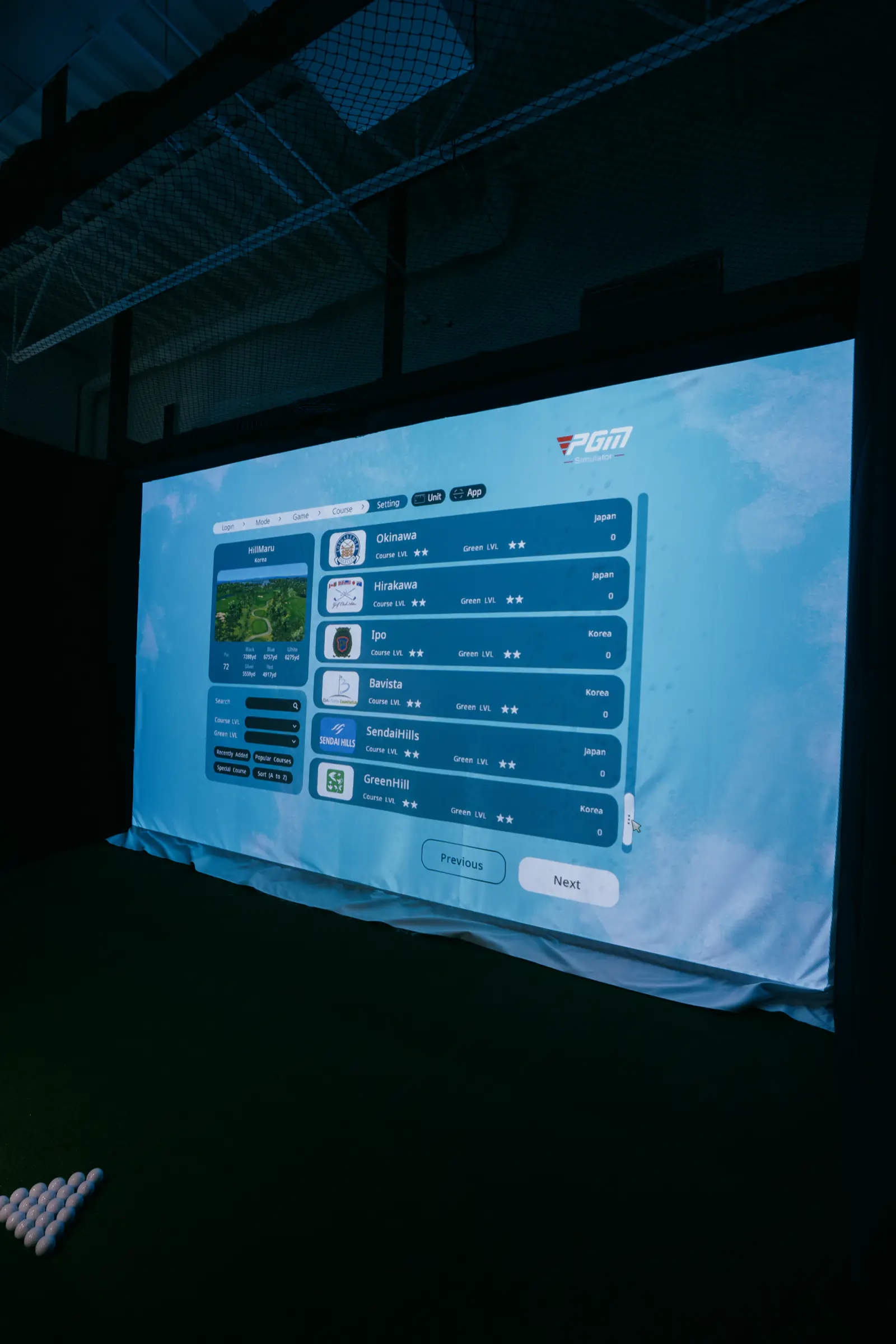
A golf simulator looks like one machine. It is really five things working together, and once you can name them the whole thing stops feeling like magic.
You hit a real golf ball with your own club at full speed. Everything else is measurement and arithmetic, finished before the ball has stopped rolling.
How golf simulators work: the five parts of a bay
- The hitting mat. A synthetic surface with a marked hitting area, so the tracking system knows where to look and you know where to stand.
- The impact screen. A tensioned screen a few metres in front of you. It takes the ball, absorbs the hit and drops it, and it doubles as the projection surface. That is why marking golf balls with a Sharpie is a problem: the ink transfers straight onto the screen.
- The projector. Fills the screen with whichever course or range you chose, from your point of view behind the ball.
- The tracking system. Sensors that watch the club through the strike and the ball as it leaves. Systems differ in where they sit and what they observe, but they are all answering the same three questions: how fast is the ball travelling, where is it pointed, and how much is it spinning.
- The software and the touchscreen. A computer turns the measurements into a flight and draws it. At PGM every one of the six bays has its own simulator and its own touchscreen, which is where you pick a course, set players up and start.
What happens in the moment after impact
Contact between club and ball is over in well under a thousandth of a second. Everything the simulator needs comes from that instant and the short stretch of flight just after it.
- You swing. The sensors capture the club through the strike and the ball as it launches.
- The software converts that intoball speed, launch angle, direction and spin, usually with club numbers alongside.
- A flight model takes those figures, applies the virtual course conditions, and works out the carry, the landing point and the bounce and roll.
- The screen draws the shot flying away from you, then posts the numbers and your distance to the hole.
- Meanwhile the real ball has hit the screen, dropped, and rolled back towards your feet.
The whole sequence finishes before you have put the club back in the bag. Worth knowing: the measured part is tight, and the modelled part after the ball leaves is a very good estimate rather than an observation.
What you can actually play
Indoor golf is not just a screen to hit into. The software is the difference between a net and a round of golf.
- Course mode. Pick a course, add players, play it like a round. The software tracks the scorecard, the distance to the pin and whose turn it is. PGM includes more than 200 virtual courses in the bay rate.
- The virtual driving range. No scorecard, no hole, just targets and as many balls as you want to hit. This is where gapping work and one-club practice happen.
- Swing Cam. Watch your swing back after a shot. Feel and reality rarely match, and video settles the argument faster than the numbers do.
All three are included in the hourly bay rate, so there is nothing to unlock and nothing extra to buy once you are in the bay.
You bring the clubs
Everything above lives in the bay. Your clubs do not. PGM does not provide clubs, so bring your own set or borrow one before you book. A driver, a mid iron, a wedge and a putter will comfortably fill a first hour.
How does indoor golf work at a self-serve venue
The technology is only half the question. The other half is what happens when you turn up at a building where nobody works on site.
- Book online. Slots come in 30-minute blocks with a 30-minute minimum. The suggested length is 1 to 1.5 hours per player, warm-up included.
- Get the confirmation email. That is your booking, with the bay and the start time.
- Get the door access link. A second email carries a link. Open it at the door and you are in. No counter, no check-in, no waiting for someone with keys.
- The bay switches on at your start time. Not before, so there is no point arriving an hour early.
- Play. You can extend on the day if nobody has booked the bay after you.
- The simulator shuts down at the end of your slot. Leave the bay clean for whoever is in next.
Because nothing in that chain needs a staff member, the doors work the same at 3 AM as at 3 PM. PGM runs 24 hours a day, every day of the year, and a remote team answers the phone on 403-680-3380 if something is not behaving. The full sequence is written out on the how it works page.
Three things first-timers ask
Is it a real golf ball
Yes. Real ball, your own club, full swing, no holding back. The screen is built to take it.
Can you putt
Yes, on the simulator green, and putts count as shots in a round on screen. It is the part of the game a simulator does least well, so treat it as keeping your stroke ticking over rather than as green reading practice.
Does a beginner get anything out of it
A first-timer and a low handicap can share a bay and both have something to do, which is hard to arrange on a real course. Beginners get instant feedback with nobody waiting behind them, and the driving range mode does not care how many attempts a shot takes.
Try it for half an hour
Reading about how golf simulators work only gets you so far. The quickest way to understand one is 30 minutes in front of it, which is the smallest block you can book. Rates start at $18 an hour for the whole bay plus GST, and the rates page shows which hours fall into which band. Pick a slot on the Calgary booking page, bring your clubs, and watch the door link land in your inbox.