
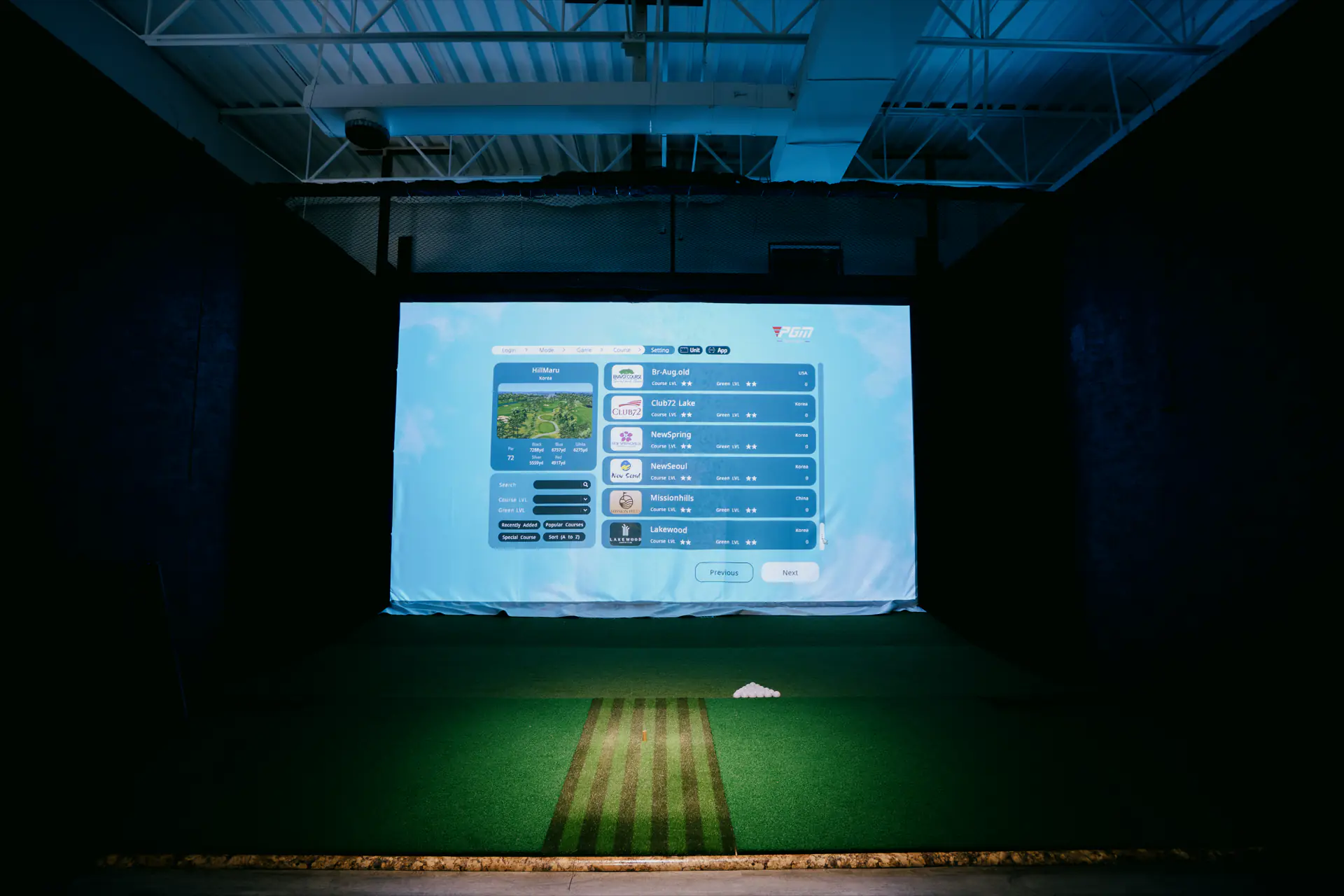
Every bay at PGM comes with more than 200 golf simulator courses and a virtual driving range, all included in the hourly bay rate. Nothing to unlock, nothing extra to pay once you are in the room.
Which creates a small problem on a first visit. Four people stand around a touchscreen scrolling a long list while the hour runs, and the group ends up on something nobody enjoys. Ten minutes of thought beforehand fixes it.
What kinds of courses are on the list
Browse the screen when you get in and you will find the same families of golf course that exist outdoors. Knowing the types is more useful than memorising names, because it tells you what a round will feel like before you commit an hour to it.
- Links. Open, windswept, firm ground, pot bunkers and very few trees. Indoors the wind is usually a setting rather than a fact, so these often play easier on screen than they look.
- Parkland. Tree lined, green fairways, water in play. The closest thing to a standard Calgary round and the most familiar starting point for most golfers.
- Desert. Target golf with generous fairways surrounded by trouble. Dramatic to look at, punishing for a beginner who sprays it.
- Mountain and resort. Big elevation changes and long views. Good for a group that wants scenery more than a scorecard.
- Short and par three courses. The most underrated option on any simulator. Every hole is reachable, rounds finish quickly, and nobody spends the evening reloading a driver.
- The virtual driving range. Not a course at all. Targets, no scorecard, and as many balls as you want.
Which specific courses are in the system changes with software updates, so treat the touchscreen as the real list and this as a guide to what to look for on it.
A first visit: pick short and forgiving
First-timers reliably choose the hardest, most famous thing on the menu and then spend 40 minutes losing balls into a virtual ocean. Do the opposite.
- Warm up on the range for ten minutes. Wedge, then mid iron, then driver. It also gets everyone used to hitting into a screen a few metres away.
- Pick something wide. Parkland or resort, generous fairways, water only in obvious places.
- Play nine, not eighteen. Finishing a short round beats abandoning a long one.
- Turn the difficulty down if the software lets you. Softer greens and shorter tees keep everyone moving.
What actually fits in one hour
This is where most groups misjudge it. A solo golfer moves quickly. Four people hitting in turn, watching each other and talking between shots do not. How long a round of golf takes runs the numbers by group size, outdoors and on a simulator.
- One player, one hour. Warm-up plus a comfortable nine, or a full range session.
- Two players, one hour. Warm-up plus nine if you keep moving, or six holes at a relaxed pace.
- Four players, one hour. Warm-up plus a handful of holes, or a closest to the pin contest on a par three course. Do not plan eighteen.
PGM suggests 1 to 1.5 hours per player including warm-up, which is the honest number for a group that wants to finish something. Bookings come in 30-minute blocks, and you can extend on the day if nobody has booked the bay after you. The rates page has a planner for working out hours by group size.
Choose before the clock starts
The simulator turns on at your start time and shuts down at the end of the slot, so browsing a list of more than 200 courses is browsing on your own dime. Agree on the format and a shortlist of two courses on the way over, then let the first person to arrive set it up.
A group where the skills do not match
Stroke play between a single-figure golfer and someone who has never held a club is miserable for both. The fix is the format, not the course. None of these need anything from the software beyond a scorecard, so you can run them by agreement in the bay.
- Scramble. Everyone hits, you all play the best ball, repeat. The beginner contributes a few good shots and nobody is ever out of the hole.
- Closest to the pin. One par three, everyone hits, closest wins. Fast, funny, and completely level if you let people choose their own club.
- Match play. Hole by hole, so a disastrous hole costs one point instead of the round.
- Stroke play. Save it for a group of similar handicaps, or for playing alone.
- Longest drive. Ten minutes on the range, everyone gets three swings, best carry wins. The clearest use of the numbers on screen.
Choosing a course for practice with a purpose
If you are there to work rather than to play, the course selection becomes a training decision.
- Gapping. Use the range, not a course. Five or six shots a club, write down the middle carry, ignore the outliers.
- Driving under pressure. Pick a tight tree lined course and play only the tee shots, replaying each hole until you find the fairway.
- Approach play. A short or par three course gives you far more wedge and short iron shots per hour than a full length round.
- Shot shaping. A desert or links layout with forced angles makes you aim at something other than the middle.
- Watch it back. Every bay includes Swing Cam, so when a number looks wrong you can usually see why in a second.
Pick two and book the bay
Decide the format, shortlist two courses, and book enough time to finish. Rates start at $18 an hour for the whole bay plus GST, the bay is yours for the slot, and you bring your own clubs. The how it works page covers the booking and the door link. When you are ready, pick a time on the Calgary booking page.