
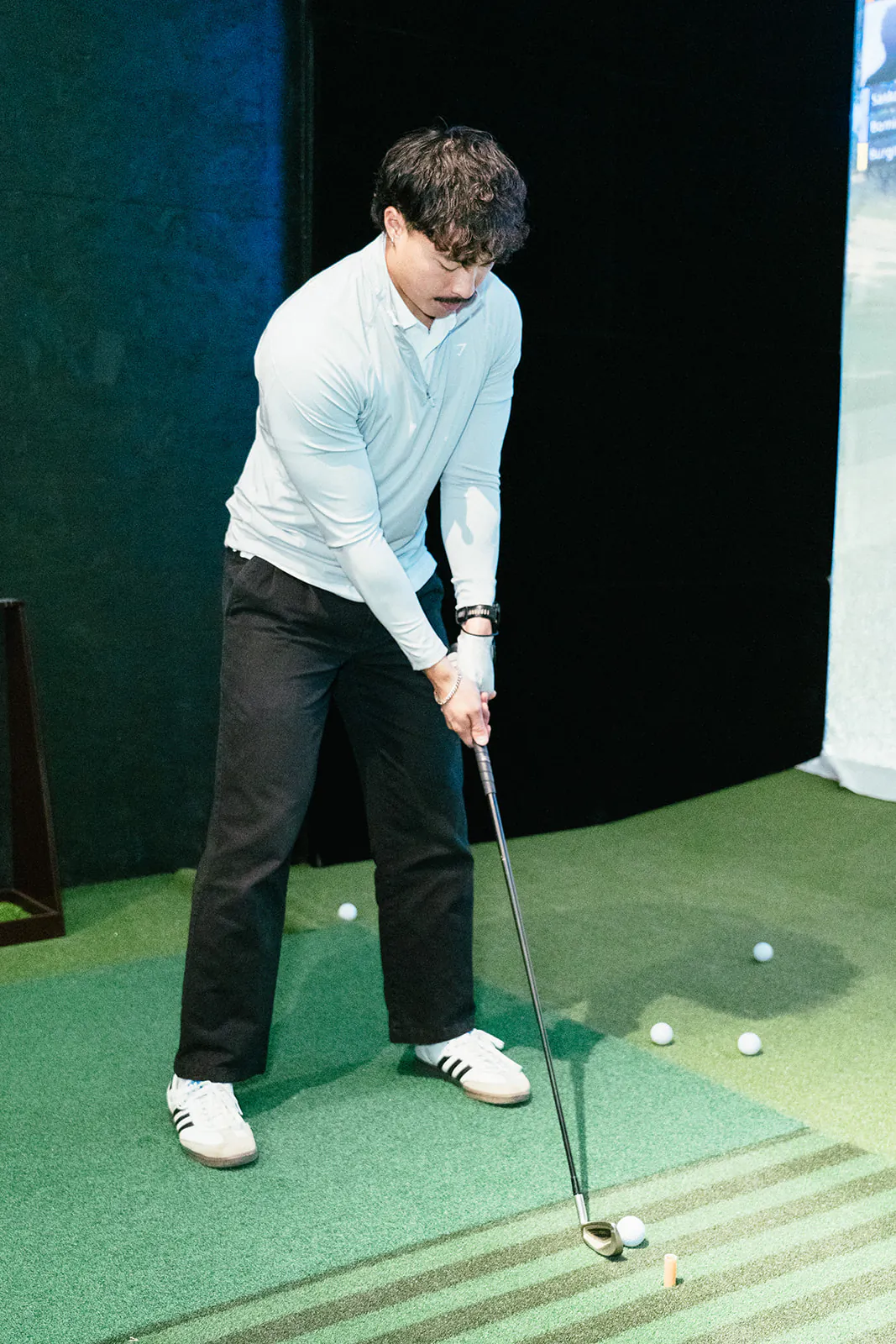
Golf simulator practice gets sold two ways, both wrong. One says a winter indoors will rebuild your swing. The other says it is a video game with a mat.
The truth sits in between and is more useful than either. A simulator is very good at feedback and repetition, and it cannot give you turf, wind or a real green. Plan around that and the answer to whether golf simulators improve your game is yes, in specific places.
Where golf simulators improve your game
- Gapping and carry numbers. The biggest single win, and the easiest. Most amateurs guess their distances and guess long. One session gives you a carry number for every club, taken from the middle of a cluster rather than from the best strike. That changes club selection on every approach without changing your swing at all.
- Strike consistency. Repetition witha reading after every ball. You find out quickly whether your pattern is a toe miss or a heel miss, which is not obvious from watching the ball fly outdoors.
- Tempo. Rhythm needs nothing from the outdoors. Count the swing, hold the count steady, and watch what happens to your dispersion on screen.
- A pre-shot routine. A routine is a habit and habits are built by repetition. Build it somewhere with no group waiting behind you and it survives the first tee in May.
- Course management. Playing a course on screen asks the same questions as playing it outside. Driver or three wood, lay up or take it on, which side of the green to miss. Those decisions transfer even when the conditions do not.
What does not transfer without extra work
- Uneven lies. Every shot indoors is flat and teed at the same height in the same spot. Every interesting shot outdoors is sidehill, above your feet, below your feet, or sitting down in rough.
- Turf interaction. A mat lets a slightly heavy strike skid into a respectable result. Grass does not. Hit only off mats and you can go a whole winter without discovering that the low point of your swing is behind the ball.
- Wind. The bay has none unless the software adds it, and Calgary usually has some. Knowing how far your own ball moves in a crosswind is an outdoor skill.
- Green reading and putting speed. The stroke is slow, the ball barely spins and the green is a model. Putting indoors keeps the stroke ticking over. It will not teach you how a Calgary green runs in July.
- Playing cold and wet. A raw April round is a clothing and patience problem more than a swing problem, and no amount of indoor golf prepares you for it.
The honest version
Nobody can promise you strokes off a handicap from indoor practice, and anyone who does is selling something. What a simulator reliably gives you is better information about your own game and more repetitions than a Calgary winter would otherwise allow. Expect the first outdoor rounds to feel different no matter how good the winter was.
How to structure a one-hour session
The default indoor session is an hour of full drivers and a sore back. This one is better, and it fits the hour exactly.
- 0 to 10 minutes, warm up. Wedges, half swings, no numbers. Ignore the screen entirely.
- 10 to 25 minutes, one technical idea. One thought, one club, building slowly to full speed. One idea, not three.
- 25 to 40 minutes, gapping. Five or six balls with each of three or four clubs. Write down the middle carry, never the longest.
- 40 to 55 minutes, play something. Three or four holes on a course, full routine before every shot, a real target each time.
- 55 to 60 minutes, write one line. What you worked on, what the numbers said, what to do next time.
If you booked 90 minutes, stretch the middle two blocks, not the warm-up.
Turning sessions into a winter
One good session proves little on its own. What changes a game is repeating the same measured session through the off-season, fixing one thing at a time. Winter golf practice in Calgary lays that out month by month, starting with a baseline in November, so it is the plan to follow once you know your numbers.
How to tell whether it is working
Do not measure this in handicap. Handicap moves slowly and leans heavily on putting, which is the part the bay handles worst. Measure three things instead.
- How tightly your 7 iron shots cluster compared with your first baseline session.
- How close your written carry numbers are to what the screen actually does on the day.
- How often you reach for the right club without thinking about it.
All three are visible on screen and all three walk outside with you in the spring.
Keeping a winter of practice affordable
Seven sessions a month adds up if you book prime evening slots. Sunday to Thursday before 9 AM is $18 an hour, the cheapest band on the board, and the rate covers the bay rather than the person, so a practice partner halves the cost. The rates page has the whole schedule.
If your sessions land early or late, the Night Owl membership at $129 a month covers unlimited bookings between 11 PM and 10 AM Sunday to Thursday, and between midnight and 10 AM on Friday and Saturday nights. At the $18 rate that pays for itself at under two hours a week, which is exactly the volume this plan asks for. The membership page lists all three tiers.
Start with the baseline session
The first session is the easy one: turn up, hit every club, write the numbers down. Everything else hangs off that page, and that page is where golf simulators improve your game. Book an hour on the Calgary booking page, bring your clubs, and give yourself a real number for every club before the snow goes.