
Ask ten golfers how accurate golf simulators are and you get ten answers, most of them shaped by one shot that read long. The useful answer is more specific than yes or no.
A simulator does two separate jobs, and they have very different error rates. Once you know which is which, you know which numbers to trust and which to shrug at.
Measured versus modelled
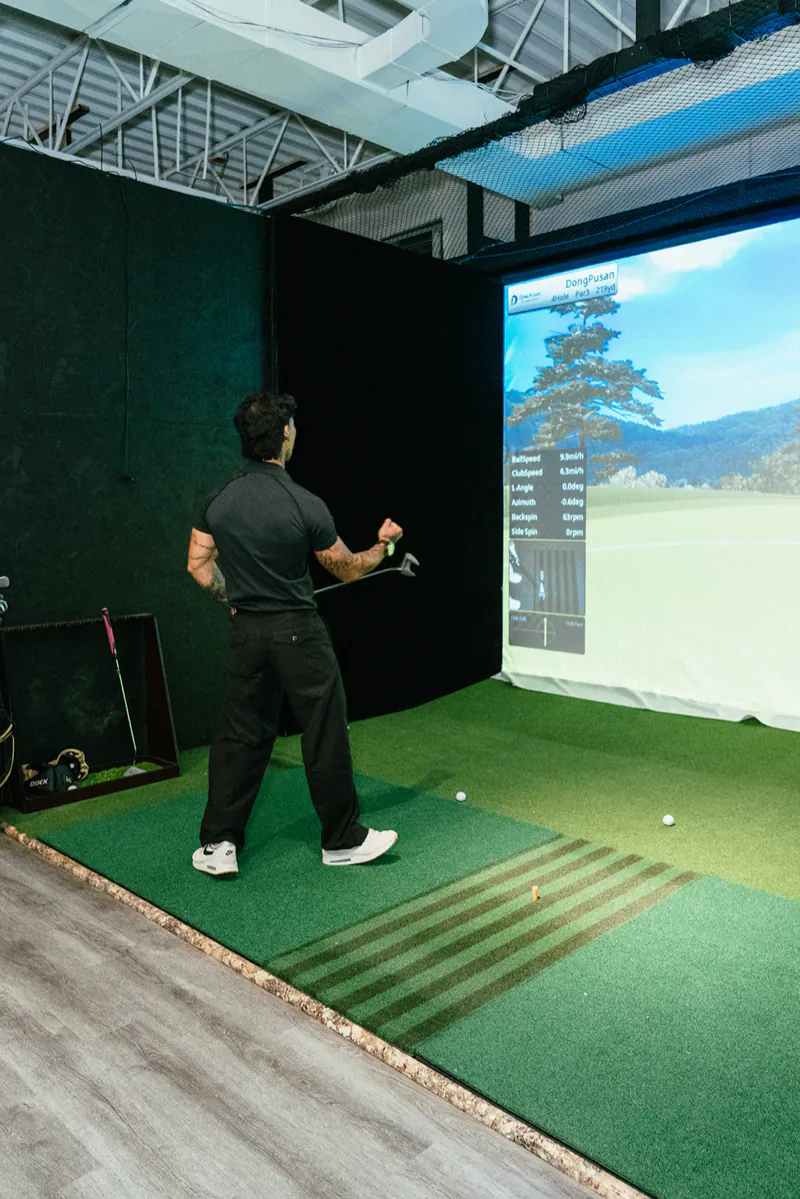
First the system measures what it can observe at impact. Depending on the setup that usually means ball speed, launch angle, direction and spin, often with club numbers alongside. This part is well understood and the error is small.
Then the software models everything after the ball leaves. The flight, the apex, the landing, the bounce and the roll are all calculated rather than watched. Air density, the ball model and the virtual ground conditions are assumptions, and assumptions are where the interesting error lives.
So the honest framing is not that indoor golf simulators are accurate or inaccurate. Measurement is tight. The model is a good estimate built on inputs that you control more than you realise.
Why carry distance is the number to trust
Are golf simulator distances accurate? Carry usually is, because carry falls out of the measured inputs almost directly. Speed, launch and spin get you to where the ball lands, with only air conditions in between.
Total distance is a different animal. It adds bounce and roll, which the software has to infer from a fairway firmness setting rather than from anything it saw. Change the course and total distance moves while carry stays put. Build your gapping chart on carry and you will be building it on the sturdier number.
What decides how accurate golf simulators are
Most complaints about accuracy trace back to one of these, not to the system itself.
- The ball. A soft urethane ball and a hard practice ball spin differently, and spin drives height, curve and stopping power. If you want numbers you can take outside, keep the ball model consistent and match it to what you play on the course.
- The mat. Every mat lets the club skid where turf would dig in. A slightly fat strike that would cost you real distance on grass can come out looking fine indoors.
- Strike quality. Off-centre hits are the hardest case for any system to read, because the spin a mishit generates has to be inferred. If one drive flies 40 metres past everything else in the session, a reading error is the likelier explanation.
- Setup and calibration. Systems expect the ball and the hitting area in a particular place. Playing from outside the marked spot degrades the read before you have swung.
- The room. Distance to the screen and ceiling height change both what the system can observe and how freely you swing. A low ceiling shortens backswings whether the golfer admits it or not.
- Putting. The weakest link in every simulator. The stroke is slow, the ball barely spins and the green is a model. Treat putting on screen as stroke maintenance rather than data.
The one-line version
Trust carry distance. Treat total distance as an estimate. Treat any single strange reading as noise. Your yardages should come from the middle of a spread of shots, never from the best one in the session.
Where indoor numbers and a Calgary course part ways
Even a perfectly calibrated bay is modelling a golf course, and a golf course in Alberta has habits of its own.
- Wind. The biggest gap by a distance. The bay has none unless the software adds it, and most Calgary rounds have some. Playing in wind is a skill you can only build outside.
- Elevation. Calgary sits around a kilometre above sea level and the ball carries further in thinner air. Check whether the software has an altitude setting before you write your numbers down, because a sea level chart will read short here.
- Lies. Every indoor shot is flat. Almost every interesting outdoor shot is not. Sidehill, uphill, downhill, rough and a ball sitting down all change strike and flight.
- Firm or soft ground. A baked August fairway and a soft one in June run the ball very differently. On screen that difference is a setting.
- Cold. A cold ball in cold air flies shorter. Your first rounds of the season will not match your winter chart, and that is the weather, not the simulator.
How to use the numbers well
Accuracy stops being an argument the moment you use the data for what it is good at. Five habits do most of the work.
- Gap on carry, from the middle. Hit five or six with each club, ignore the outliers at both ends, and write down the middle carry. That is your number.
- Watch dispersion before distance. How tightly your shots cluster tells you more about your week than any single long one.
- Work on strike, then tempo. Neither needs the model to be perfect. Centre contact and a repeatable rhythm show up in the numbers immediately and travel outdoors intact.
- Compare yourself to yourself. Same bay, same ball, same settings, four weeks apart, is a real comparison. Your screen against a spec sheet or somebody else's photo is not.
- Record the conditions. Ball, mat, altitude setting and course. A number without its conditions is not evidence of anything.
It also helps to look as well as read. Every bay at PGM includes Swing Cam, so when a number looks wrong you can watch the swing back and usually see why in a second. Feel and reality rarely match, and video settles it faster than the data does.
Go and find your own numbers
A simulator is a measuring tool with a very good picture attached. Used carefully it will give you a gapping chart you can take to the first tee in May, and used carelessly it will give you one long drive to talk about. The how it works page covers what is in each bay, and the rates page shows when the $18 hours fall. Book a slot on the Calgary booking page, bring your clubs, and start the chart.