
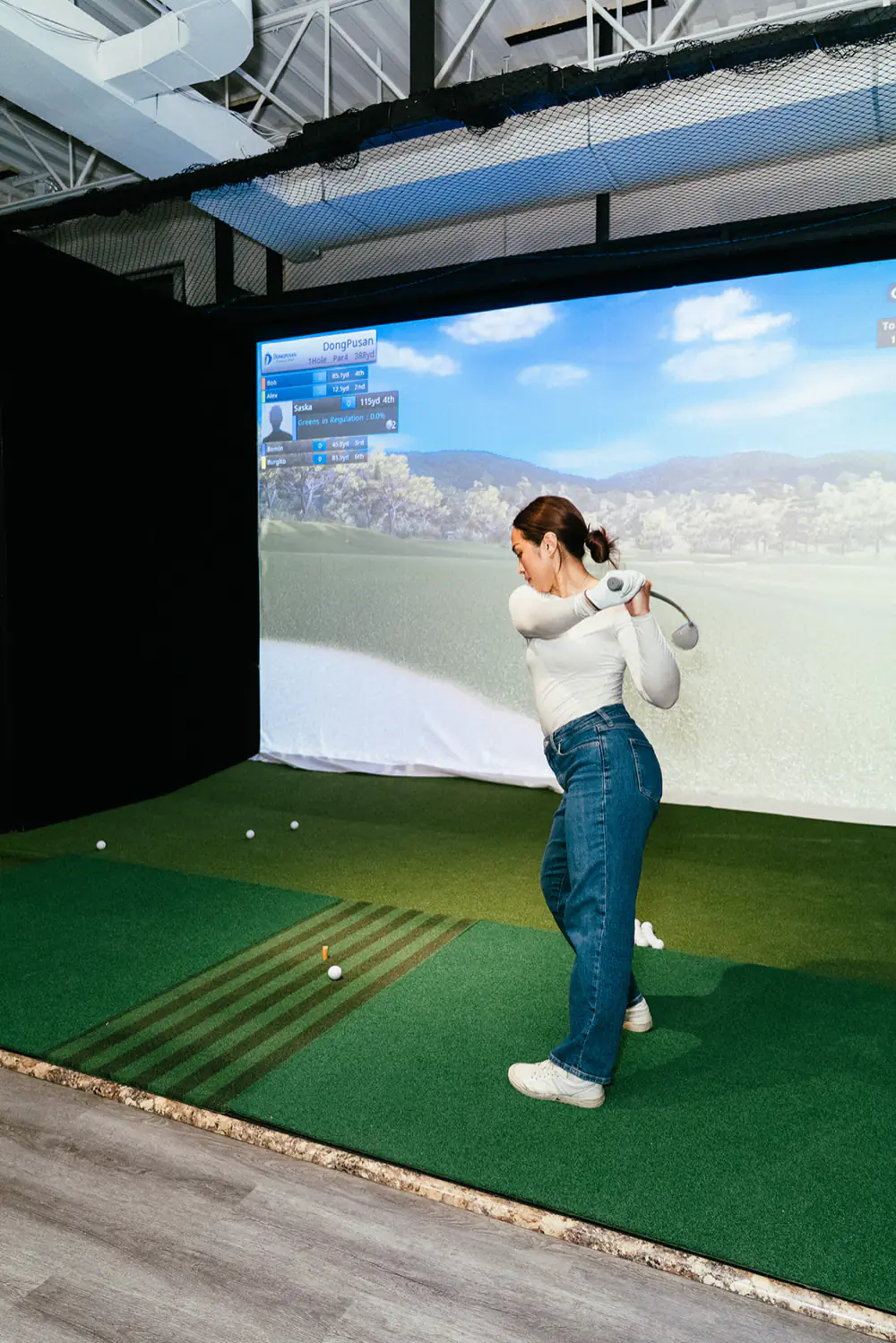
Golf simulator vs driving range is not really a contest. They are two tools that answer different questions, and the golfer who uses both gets more out of a Calgary year than the one who picks a side and defends it.
Here is the honest version: what each one is better at, where the range wins outright, and how to decide on any given week.
What each one actually gives you
A range gives you a ball, a target and open air. You judge the shot with your own eyes. That feedback is real, it is immediate, and it is rough. Nobody writes anything down.
A simulator gives you a number after every swing. It measures what it can observe at impact, models the flight from there, and draws the result on a screen a few metres in front of you. The feedback is precise, and the ball never leaves the room.
Everything else in the indoor vs outdoor practice argument follows from that one difference.
Where the simulator is better
- Numbers you can act on. Carry distance, launch, spin and direction after every shot. Gapping stops being a guess based on the one seven iron you remember well.
- Video. Every bay at PGM includes Swing Cam, so you can watch the swing back. Feel and reality rarely match, and a range has no way to settle that argument.
- It is golf, not just hitting. A bay plays full rounds. PGM includes more than 200 virtual courses and a virtual driving range in the bay rate, so you can play a hole, miss the green and work out the up and down.
- The clock. PGM runs 24 hours a day, every day of the year, and bookings start at 30 minutes. A half hour before work is a real practice option indoors and not much of one outdoors.
- Privacy. Six private bays, and your group has one to itself. A beginner can swing badly for 20 minutes without an audience in the next stall.
Where the driving range is better, plainly
This is the part most indoor golf pages skip. The range does several things a screen cannot.
- Real ball flight. You watch the ball climb, turn and land. Judging shape and trajectory with your own eyes is a skill, and it only develops when there is a ball to follow.
- Wind. The single biggest gap. Holding a low one into a breeze, or trusting a club less downwind, cannot be learned in a still room.
- Volume. A large bucket is the cheapest way to hit a lot of balls in a row. If the plan is 120 swings to groove a change, the range does it for less.
- Turf. Off grass, a fat strike costs you distance and tells you so. Every mat lets the club skid a little, which flatters exactly the miss you want to find.
- Distance by eye. Picking a target 120 metres away and judging the result without a readout is closer to the real thing.
So say it straight: if it is July, you have two hours and you want to hit a hundred balls off grass into moving air before a weekend round, go to the range. That one is not close.
Simulator or driving range, line by line
- Feedback. Range: your eyes. Simulator: measured numbers plus video.
- Ball flight. Range: real, all the way to the ground. Simulator: measured at launch, modelled after that.
- Wind and lies. Range: whatever the day hands you, off grass or mat. Simulator: flat and still unless the software adds something.
- Balls per dollar. Range: high. Simulator: fewer swings, far more information per swing.
- Season. Range: roughly spring to autumn in this city. Simulator: every month.
- Scoring. Range: none. Simulator: full rounds, scorecard and all.
- How you pay. Range: a bucket, per person. PGM: per bay, per hour, shared by everyone in the bay, plus GST.
The money works differently
A bucket is priced per golfer. A bay is priced per bay, so four people split one hourly rate. At PGM that is $18 an hour before 9 AM Sunday to Thursday, before 10 AM Friday and Saturday, and from 11 PM Sunday to Thursday, $30 an hour through most of the week, and $35 an hour Friday from 6 PM and Saturday from 10 AM. All plus GST, in 30-minute blocks. The rates page lays out which hours fall where.
What the Calgary calendar does to the decision
For a good part of the year this stops being a choice. Between late autumn and spring the outdoor option is mostly unavailable here, so indoor vs outdoor practice becomes indoor practice or none. That is the stretch where a bay is not competing with a range at all, it is competing with doing nothing until May.
In summer the calculation flips, with one exception. The hours are still the simulator's advantage. A bay at 6 AM before work or 11 PM after a shift is time you would not otherwise have spent on golf, and those are the cheapest hours on the schedule. At 6 AM, start with a 10 minute warm-up routine before the first full swing.
A sane way to split the two
- Build the gapping chart indoors. Five or six shots a club, write down the middle carry, ignore the outliers. Nothing moves, so the numbers mean something.
- Test it outdoors. Take the chart to the range and see how it behaves in moving air.
- Use the range for reps. Swing changes need volume, and volume is what a bucket is for.
- Use the bay for decisions. Playing a hole on screen forces a club choice, a target and a consequence. A range never does.
- Use the bay for the hours nothing else covers. Early, late, and the six months in between.
One practical note. PGM does not provide clubs, so bring your own set. A driver, a mid iron, a wedge and a putter will fill a first hour.
Try the indoor half for half an hour
If you have only ever hit at a range, 30 minutes in a bay is the cheapest way to find out what the numbers add. Rates start at $18 an hour for the whole bay, plus GST. The how it works page covers booking, the door link and what is in the room, and anything else is on the FAQ. Pick a slot on the Calgary booking page and bring your clubs.