
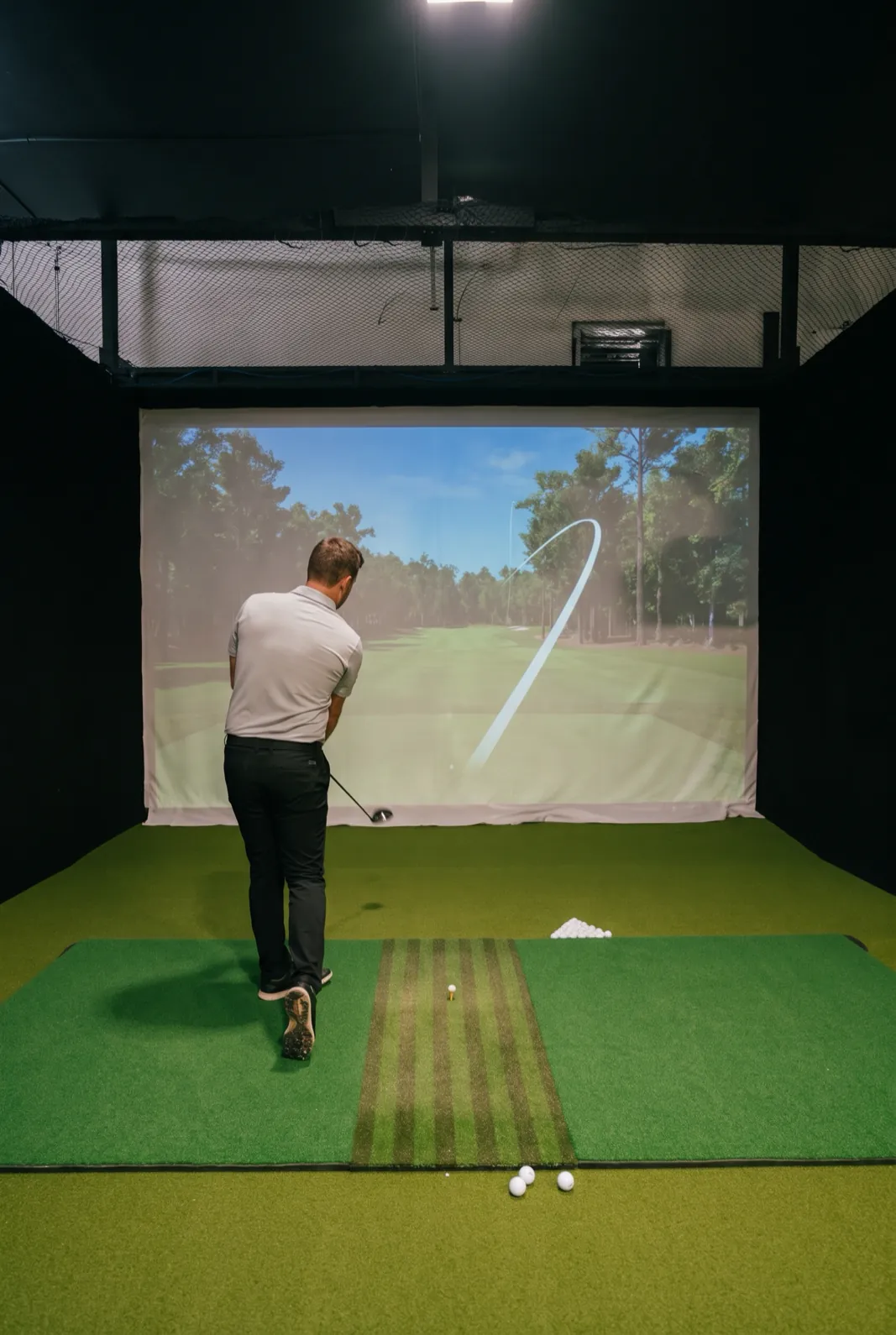
Most golfers who slice have tried a dozen tips and kept none of them. The usual reason is that the tip fixed the wrong half of the problem. Learning how to fix a slice starts with knowing which half you have.
What a slice is
For a right-handed golfer, a slice is a shot that curves hard to the right, often bending more as it falls. A fade is the same shape in a small, controlled dose. A slice is the version you did not ask for, and it costs distance as well as direction.
Left-handed golfers see the mirror image: the ball curves left. Everything below works the same way with left and right swapped.
The two causes, in plain words
Two things at impact decide where the ball goes. The clubface sets most of the starting direction. The difference between where the face points and the path the club is travelling on sets the curve.
- The face is open to the path. If the face points right of the direction the club is swinging, the ball curves right. Every slice has this in it.
- The path is out to in. The club travels from outside the target line to inside it, cutting across the ball. That does not curve the ball by itself, but it makes a face that is open to the path very easy to produce, and the ball often starts left before it bends right.
Most slices are a mix of both, and they feed each other. The ball goes right, so the golfer aims further left and swings further across it, and the curve gets bigger.
How to diagnose your slice
Read the ball flight
- Starts left, curves right. An out-to-in path with the face open to it. The classic pull slice.
- Starts straight, curves right. The face is open to a path that is close to straight.
- Starts right, curves further right. The face is open to the target and to the path. Often more of a grip or face problem than a path one.
Read the numbers, if your bay shows them
Many simulators show club path, face angle and spin axis. A slice usually shows up as a face angle more open than the club path, with the spin axis tilted towards the right. Our post on golf simulator numbers explained covers what each figure means and how most screens label left and right.
Watch it on Swing Cam
Every bay at PGM includes Swing Cam for watching your swing back. Look at the start of the downswing. If the club moves out towards the ball and the shoulders open early, the path is coming from the outside. Check the clubface at the top as well, where the view allows it.
How to fix a slice with driver and irons
Match the fix to the diagnosis. If the ball starts right, begin with the grip and the face. If it starts left, begin with setup, alignment and path.
- Grip. A grip turned too far towards the target makes the face hard to square. Turn both hands slightly away from the target on the handle, until you can see two or three knuckles on your lead hand at address. Make small changes, a few balls at a time.
- Setup and ball position. Check that your shoulders sit parallel to the target line, not open to it. With a driver, the ball usually sits off the inside of the lead heel. Too far forward and the shoulders tend to open to reach it. With irons, play it nearer the middle of the stance.
- Alignment. Lay a spare club or your own alignment stick along your toes, parallel to the target line, and keep it well clear of the ball and the hitting area. Aiming left to allow for the slice makes the path worse, so aim at the target and let the ball tell you the truth.
- Path drill with a headcover. Place a soft headcover a few inches outside the ball and slightly behind it. An out-to-in swing clips it on the way down. Swing so the club passes inside it, starting with half swings.
- Tempo. Rushing from the top is a common way to throw the club outside. Swing at three-quarter speed, count one on the way back and two on the way through, and keep the count the same on every ball.
One change at a time
Change the grip, hit ten balls, look at the result, then decide whether to keep it. Changing grip, setup and path in the same five minutes leaves you with no idea which one helped. Expect a new grip or path to feel strange, and the results to be uneven before they settle.
A practice plan for one bay session
Bookings come in 30-minute blocks, and this plan fits an hour.
- 0 to 10 minutes, warm up. Ourgolf warm up routinetakes ten minutes. Do the stretching part before you start the clock.
- 10 to 20 minutes, baseline. Ten drivers with your normal swing. Note where each one starts and how much it curves, plus the face and path numbers if your bay shows them. Watch one swing on Swing Cam.
- 20 to 40 minutes, one fix with a mid iron. Pick the fix that matches your diagnosis. Half swings, then three-quarter, with the headcover drill if the path is the issue. Check Swing Cam once halfway through.
- 40 to 50 minutes, driver with the same fix. Ten balls. Compare the start line and the curve with your baseline.
- 50 to 60 minutes, play two or three holes. One ball, full routine, a real target. See whether the change holds when there is a score attached.
Write one line before you leave: what you changed and what the curve did. The next session starts from there.
What to expect
A slice built over years rarely leaves in an hour, and nobody can promise a timeline. What helps is steady sessions with one change at a time and an honest look at the ball flight. The how it works page explains booking and door access, and the rates page shows when the cheapest hours fall. When you are ready, pick a slot on the Calgary booking page and bring your clubs.